LORD KAI / THE STORY BEHIND THE SONG
Strange
Frontier
Music from a Lucid Dream — Lord Kai
Strange Frontier is more than a song to me. It represents the realization of something I've dreamed of accomplishing for most of my life, and one of the most direct connections between my dreaming and waking experiences that I've ever achieved.
When I was a child, I remember listening to a radio interview with a musician who described how she would compose music in her dreams, then wake up, write it down, and perform it in the physical world. The idea fascinated me. The possibility that someone could create an entire piece of music while dreaming, then carry that creation across the boundary into waking reality, seemed almost magical.
It was something I never forgot.
Over the following decades, I spent countless hours exploring dreams, consciousness, and lucid dreaming. I experienced varying degrees of success becoming lucid, but the ability to intentionally compose music within a dream, retain it, and bring it back into waking life always felt just beyond my reach.
Until now.
The Dream
The experience began deep within a dream, when I started hearing music. What made it unusual was that the music wasn't coming from a speaker, an instrument, or anything in the environment around me. I was simply thinking of music, and as I imagined it, I could immediately hear it.
That realization triggered my lucidity.
Recognizing what was happening, I found a nearby desk, sat down, conjured a pencil and paper, and began writing lyrics as they came to me. At the same time, I discovered that I could manipulate the music itself through imagination, and hear it in real time. I could imagine different synthesizers, instruments, melodies, and sounds entering the composition, and hear them materialize as I thought of them.
For a brief period, I was both the composer and the listener, creating music through imagination alone.
I continued writing and experimenting until, somewhere near the end of the composition, I fell asleep in the chair within the dream.
What followed was a remarkable series of nested dream experiences.
I awoke into another dream environment, one that was already familiar to me from a previous dream. It resembled a float center where I work, but expanded into an enormous adobe-style building reminiscent of Santa Fe, New Mexico. It contained numerous float rooms, a coworking space, a café, and a shop. On my previous visit to this dream location, it had been almost entirely empty. This time, it was bustling with people. I remember telling my boss how busy the place had become and seeing her excitement at the activity filling the building.
Eventually, I fell asleep again within that dream and seemed to awaken another level closer to waking consciousness.
This time, I found myself with a small group of friends beside a flowing creek. We were gathered on a tiny island in the middle of the water, sitting in lawn chairs positioned so close to the creek that our feet could rest in the current.
I had apparently told my friends about the music I'd composed several dream levels deeper, and they were excited to hear it. They encouraged me to play the track.
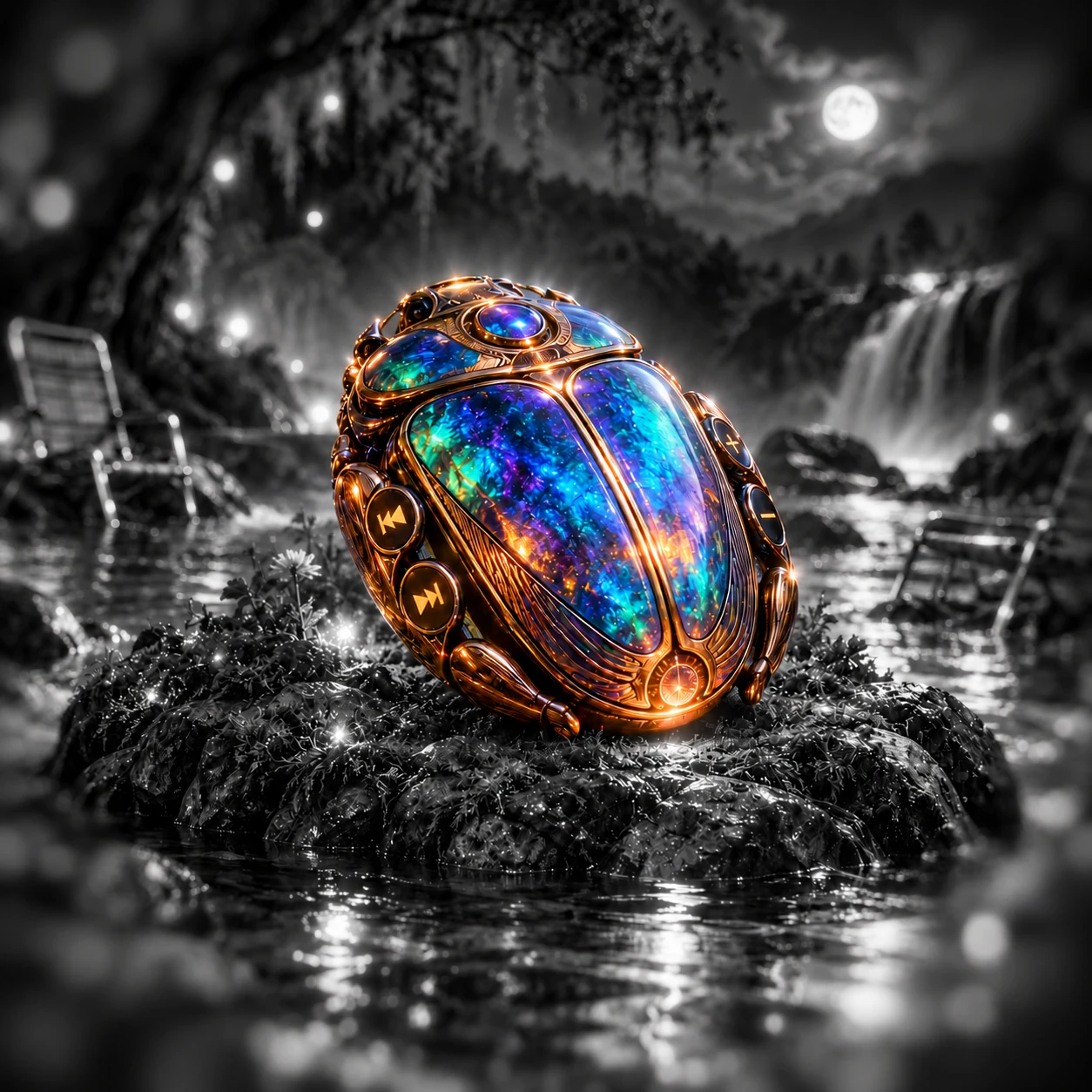
I remember holding a peculiar remote control shaped like a brightly colored scarab beetle. At first, it seemed almost alive, crawling around on its own. But as I examined it, the creature tucked its legs beneath its body, revealing volume controls and buttons for changing tracks along its sides.
Using this strange little device, I played the song through a Bluetooth speaker, and we sat together in the creek listening to the music I'd created.
It was as though I'd carried the composition from one dream into another, and then another, until I was sharing it with an audience inside the dream itself.
And when I finally awoke in the physical world, something extraordinary had happened.
I remembered the lyrics.
Bringing the Music Back
For the first time in my life, I had successfully composed a song within a lucid dream and retained enough of it to reconstruct it while awake.
I immediately worked to preserve what I remembered, including the lyrics, musical progression, and distinctive sounds that had accompanied the experience.
Using AI-assisted music production, I began translating those memories into a finished recording. The song moves from atmospheric future bass into melodic drum and bass, gradually building through rolling rhythms, expansive synthesizers, and soaring melodic passages.
After experimenting with different generations, I eventually produced a version with uncanny similarity to what I'd heard in the dream. The first few generations were close but what aligned the sound completely turned out to be using my own voice as the basis for the vocals.
Hearing it was an experience of its own. Something that had existed only within my dreaming consciousness had taken on a form I could listen to again, share with others, and preserve in the waking world.
The accompanying artwork depicts the scarab-shaped remote control from the dream, sitting beside the moonlit creek where I remember sharing the original composition with my friends.
What Strange Frontier Means to Me
The lyrics themselves explore dream worlds, shared consciousness, imagination, and the possibility of reaching extraordinary places through the mind.
Lines like "This place is mine / Not mine alone / We can reach it / From a shared tone" reflect something I find deeply meaningful about exploring consciousness: even our most private inner experiences can become opportunities for connection when we find ways to communicate them.
The song also moves through themes of loss, joy, freedom, choice, and exploration. These are all ideas that have shaped my relationship with dreams and my curiosity about the nature of consciousness.
But beyond the lyrics, the existence of the song itself is what matters most to me.
For decades, I'd carried the memory of that childhood radio interview and the belief that composing music in a dream was something other people could do, but perhaps I never would.
Strange Frontier changed that.
It represents the crossing of a boundary I'd once believed was inaccessible. Not because the boundary between dreaming and waking has disappeared, but because I was finally able to bring something meaningful across it.
What began as a melody imagined in a dream became a song that now exists in the physical world.
And perhaps that's the most important meaning behind the title.
The strange frontier isn't necessarily somewhere far away. Sometimes it's the boundary between what we imagine is possible and what we discover we can actually do.