01 / ENTER
Everyone has a chance.
Walk up, participate, and become part of the story. Entry was designed to be free; you didn't need to donate a prize to enter.

A little civic theater. A lot of unnecessary paperwork. A sincere attempt to make people feel that extraordinary things can happen to them.
Some of the most meaningful moments at Burning Man are the ones you couldn’t possibly schedule. A stranger pulls you into a story. An ordinary interaction becomes a little myth. For a minute, the world seems to be conspiring in your favor.
One of my favorite concepts at Burning Man has always been playa magic. Since I first attended in 2004, I’ve returned to Black Rock City many times, and over the years I’ve heard that phrase used more and more to describe something remarkably familiar: those seemingly random events that become mind-bending coincidences when you realize just how improbable they were.
A chance encounter happens at precisely the right moment. An unlikely series of events delivers exactly the person, object, or experience you didn’t know you needed. It can sound almost made up when you tell the story afterward—yet you were there, watching it unfold.
I’ve experienced glimmers of this at other transformational festivals, too. But the sheer concentration of these occurrences at Burning Man feels extraordinary. I suspect those unexpected, magical moments are among the biggest reasons so many people keep returning. They’re certainly one of the reasons I do.
I started Playa Magic around a question: what if we could deliberately create the conditions for more of those moments? Not manufacture the outcome. Not control the story. Just build a playful invitation for people to step into it.
I also wanted a camp culture that welcomes curiosity before credentials. Newcomers, longtime Burners, people in spectacular outfits, people still figuring out what the city means to them—none should have to pass a test of being “Burner enough” to belong. Belonging shouldn’t have a velvet rope.
That openness is part of the magic itself. The more willing we are to notice an invitation, follow an unexpected impulse, talk to a stranger, or participate without knowing the outcome, the more opportunities we give the improbable to find us. To me, Playa Magic is both an experience to create and a spirit of curiosity to carry into the city.
Make people feel noticed into belonging. Make the moment bigger without making anybody smaller.The spirit behind Playa Magic
A free gift-economy lottery for a city built on gifting. And an official-looking organization with absolutely no reason to exist.
Across all my years of attending Burning Man since 2004, I’d encountered just about every kind of participatory offering I could imagine—but I couldn’t recall ever seeing a lottery. The novelty was irresistible. Even better, the idea fit the name Playa Magic almost perfectly: luck, chance, probability, and the possibility of something wonderful arriving from nowhere.
So I created the BRC Lottery as Playa Magic’s first major participatory experience, and founded the BRC Lottery Commission to give it an appropriately absurd institutional identity. The Commission is deliberately fictional: an officious-sounding organization with seals, proclamations, tickets, and an entirely unreasonable commitment to ceremonial paperwork. It is participatory art, not a government agency or an official Burning Man program.
The lottery is a gift-economy experiment from start to finish. Entry is free, and contributing a prize is completely voluntary. Gifts, objects, services, curious artifacts, and offered experiences can all become part of the prize pool. Chance does the pairing between participants and contributions. What someone receives isn’t determined by purchasing power or by knowing the right person: it’s determined by luck.
The best outcome might not even be the gift itself. It might be the mystery surrounding it, the unexpected interaction that delivers it, or a seemingly ordinary object that becomes a story somebody tells for years.
And sometimes the first step into playa magic is almost laughably simple. You notice a sign or an intriguing object, feel the urge to investigate, and choose to participate—even if no one is standing there explaining what to do. By following that whim, you’ve opened yourself to a possibility that wouldn’t exist if you’d just kept walking.

Walk up, participate, and become part of the story. Entry was designed to be free; you didn't need to donate a prize to enter.
Objects, experiences, services, and other gifts could become somebody else's improbable surprise.
A drawing and a playful delivery ritual were designed to connect participants with prizes, including people not standing at the ceremony.
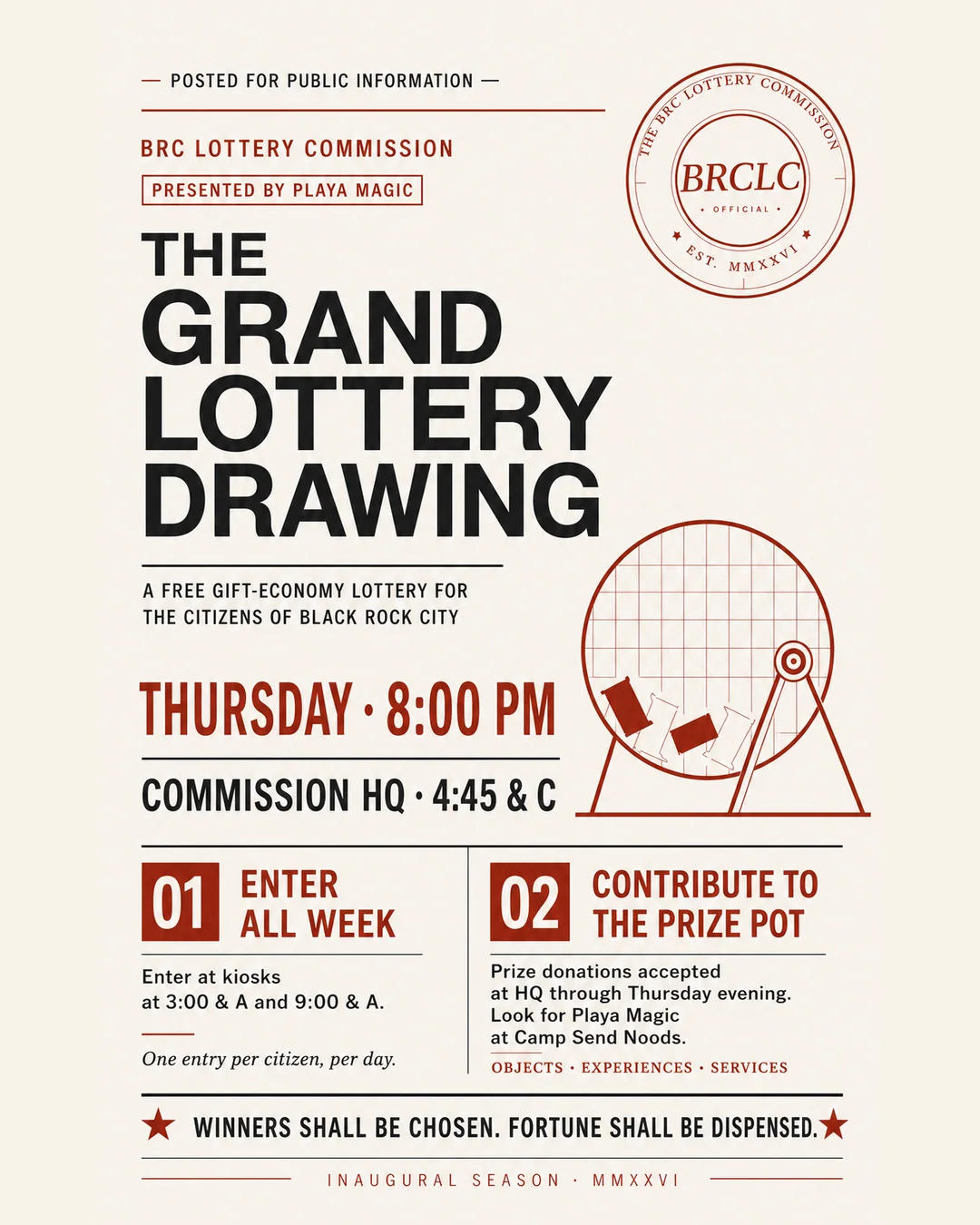
The 2026 debut of Playa Magic took shape as an independent activation hosted by Camp Send Noods at 4:45 & C. The BRC Lottery came with its own visual language: a sharp, electric wordmark, an absurdly credible Commission seal, and posters announcing a grand drawing as though it were a major civic obligation.
There was more than branding behind it. People filled out handwritten entries; community members contributed prizes; others helped with deliveries. Something that began as an improbable idea had acquired real participants and real stories.
The 2026 activation left a lasting paper trail and a record of real participation—a little archive of the people who said yes to an unlikely idea. Meanwhile, the kiosks, courier systems, and ceremony formats remain wonderfully open-ended design questions, with room to iterate, improve, and reinvent them as Playa Magic grows from one year to the next.
The first lottery left behind an unexpectedly revealing archive: paper forms, uncertain calendars, memorable names, camp addresses, and tiny notes from strangers.
The BRC Lottery Commission's first retrospective turned the collection into a lovingly over-serious field report. It became a small work of data storytelling, with a careful audit of repeated entries, partial handwriting, and responses that were — let's say — highly compatible with Black Rock City.
One plea from the Commission’s very overworked Department of Handwriting: if you’d like to help us digitize the entry process—thoughtfully, and with participants’ privacy in mind—please get in touch. We’d love for the next post-playa field report to require fewer hours of deciphering dust-covered forms, leaving more time for entirely unnecessary bureaucracy.
*The 166 forms include 41 in an initial interest/contact pile and 125 in the regular entry pile. Two were message-only sheets. Three apparent repeat entrants accounted for additional forms, yielding 159 apparent individuals, not a verified unique-person census. The reported-age median uses 145 apparent individuals with readable numeric ages. These are results from submitted forms, not estimates of total event traffic or all Black Rock City participants.
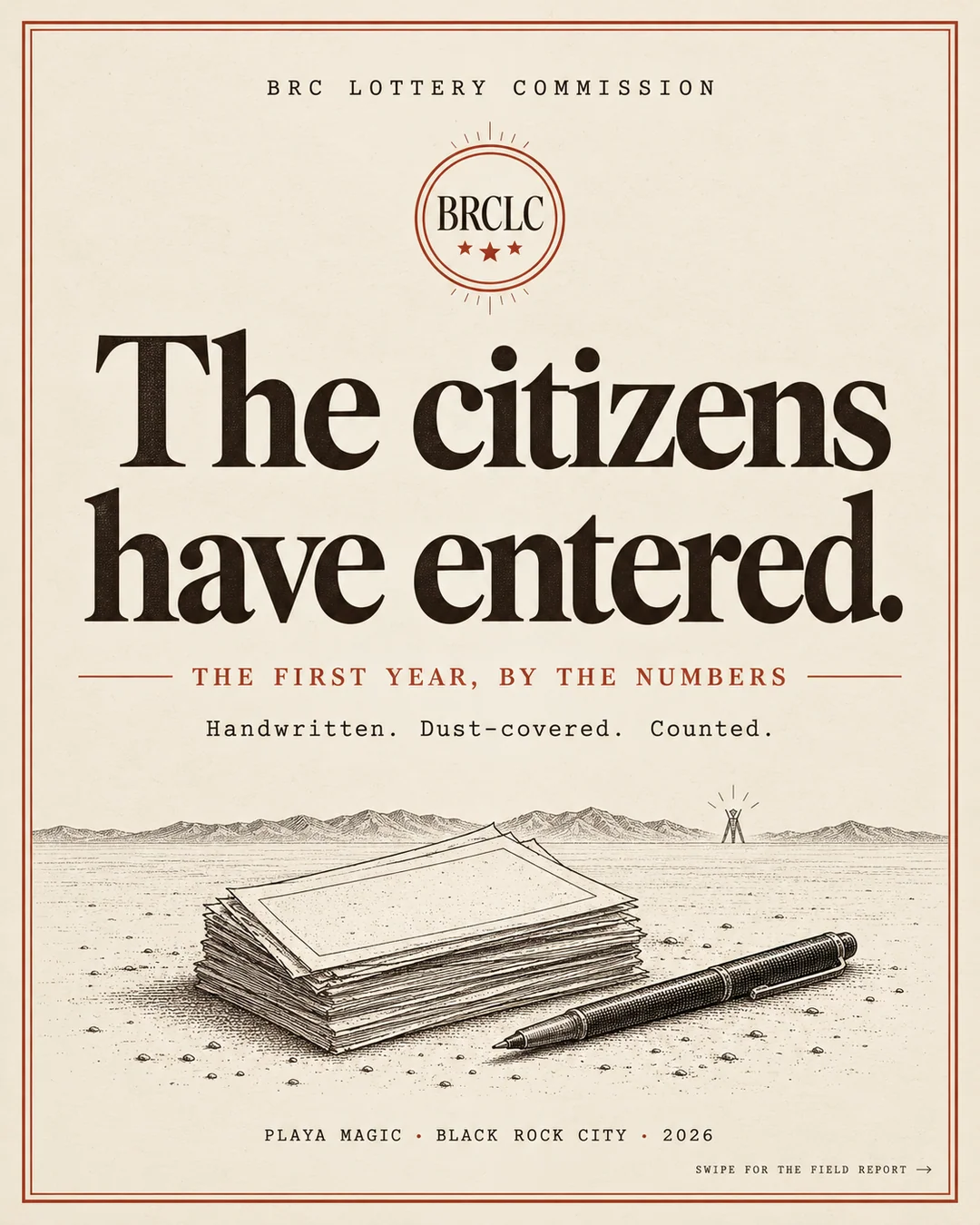
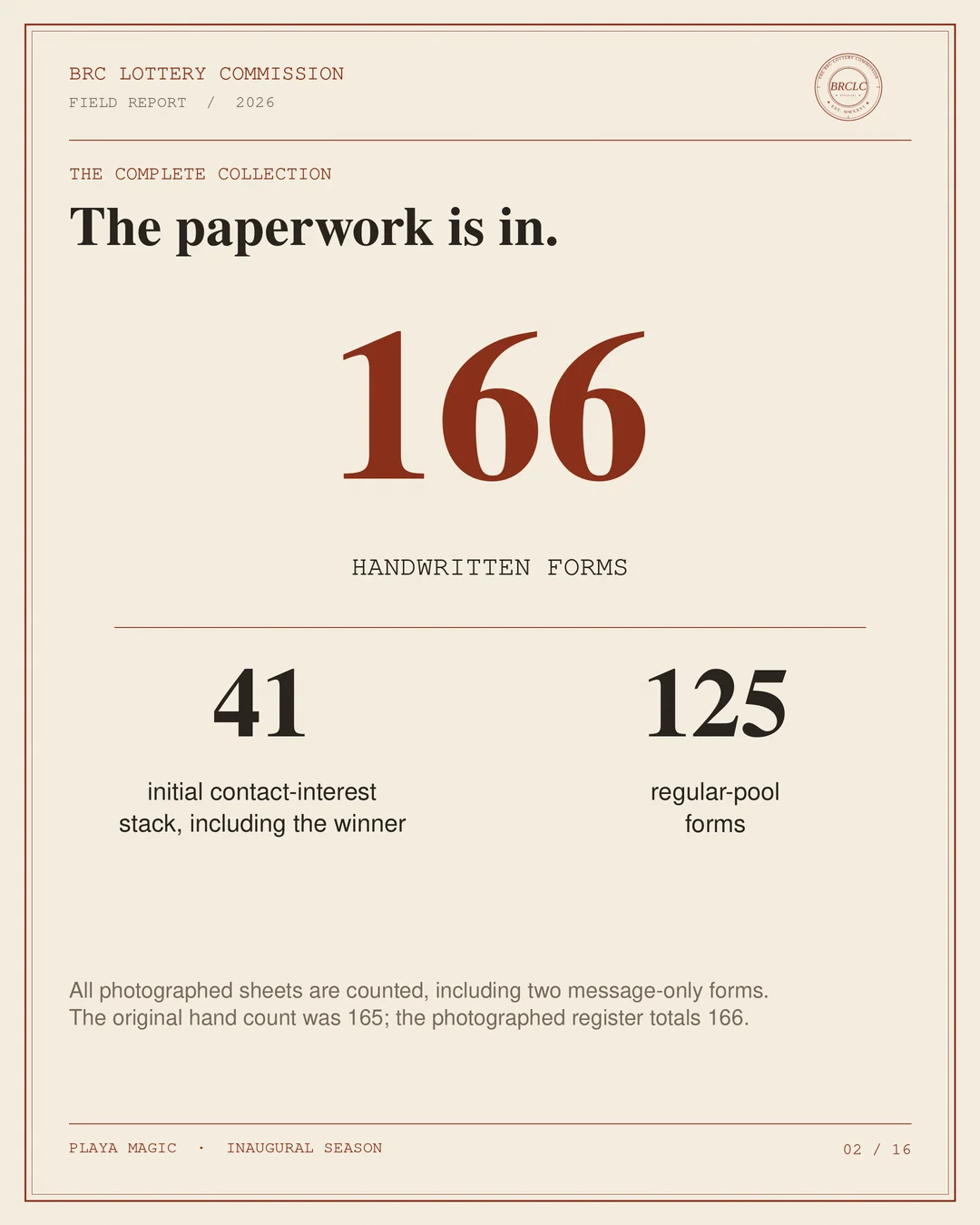
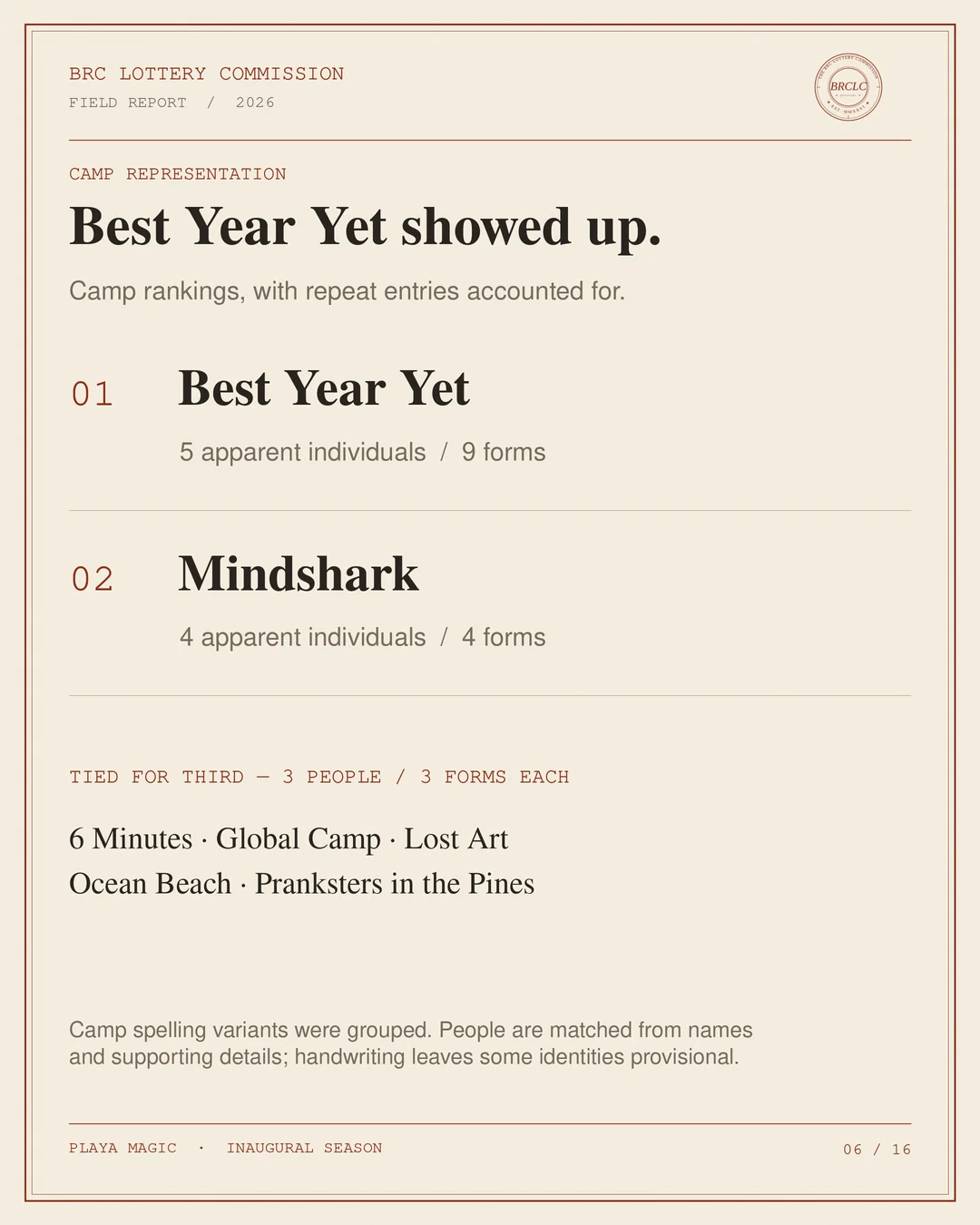
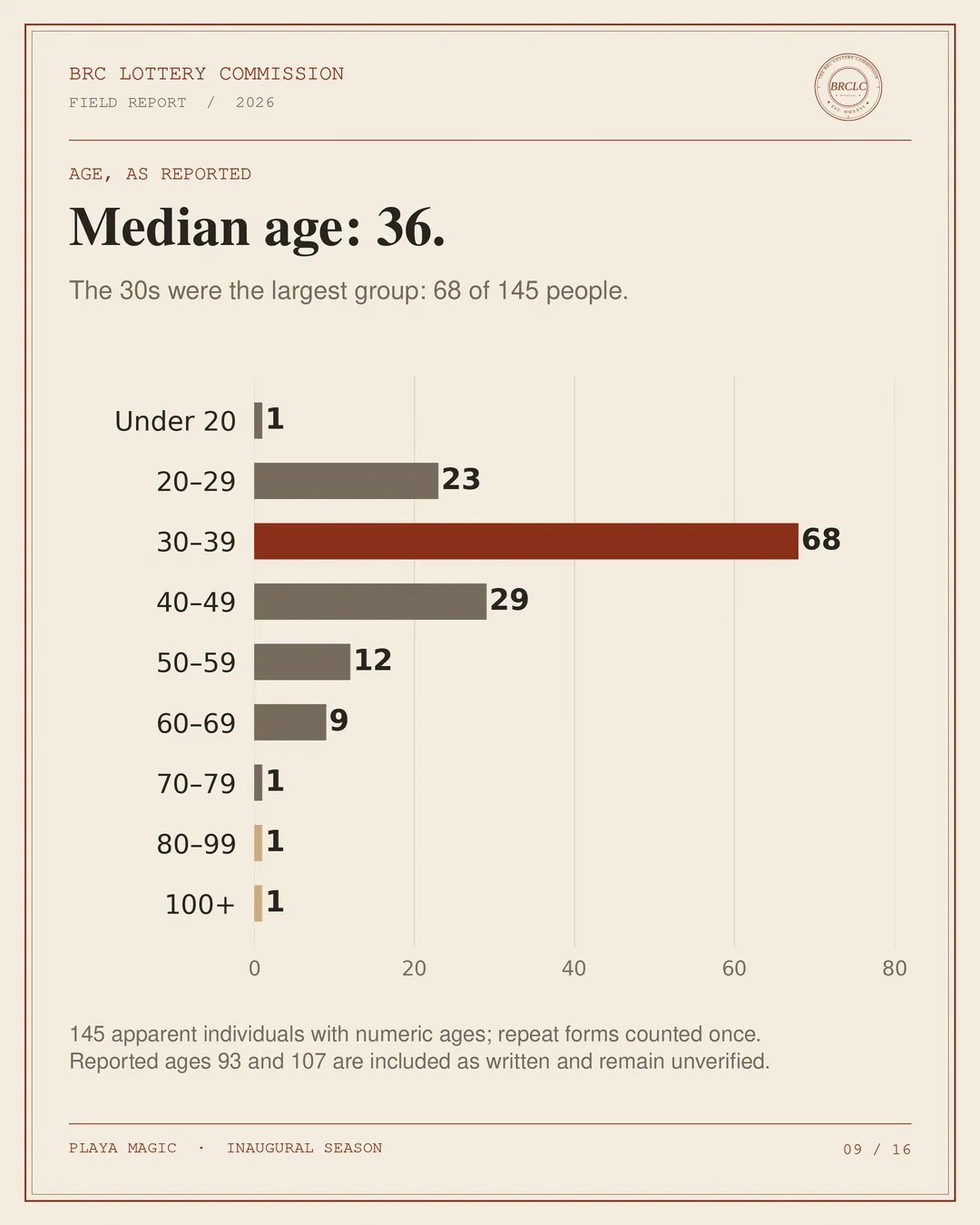
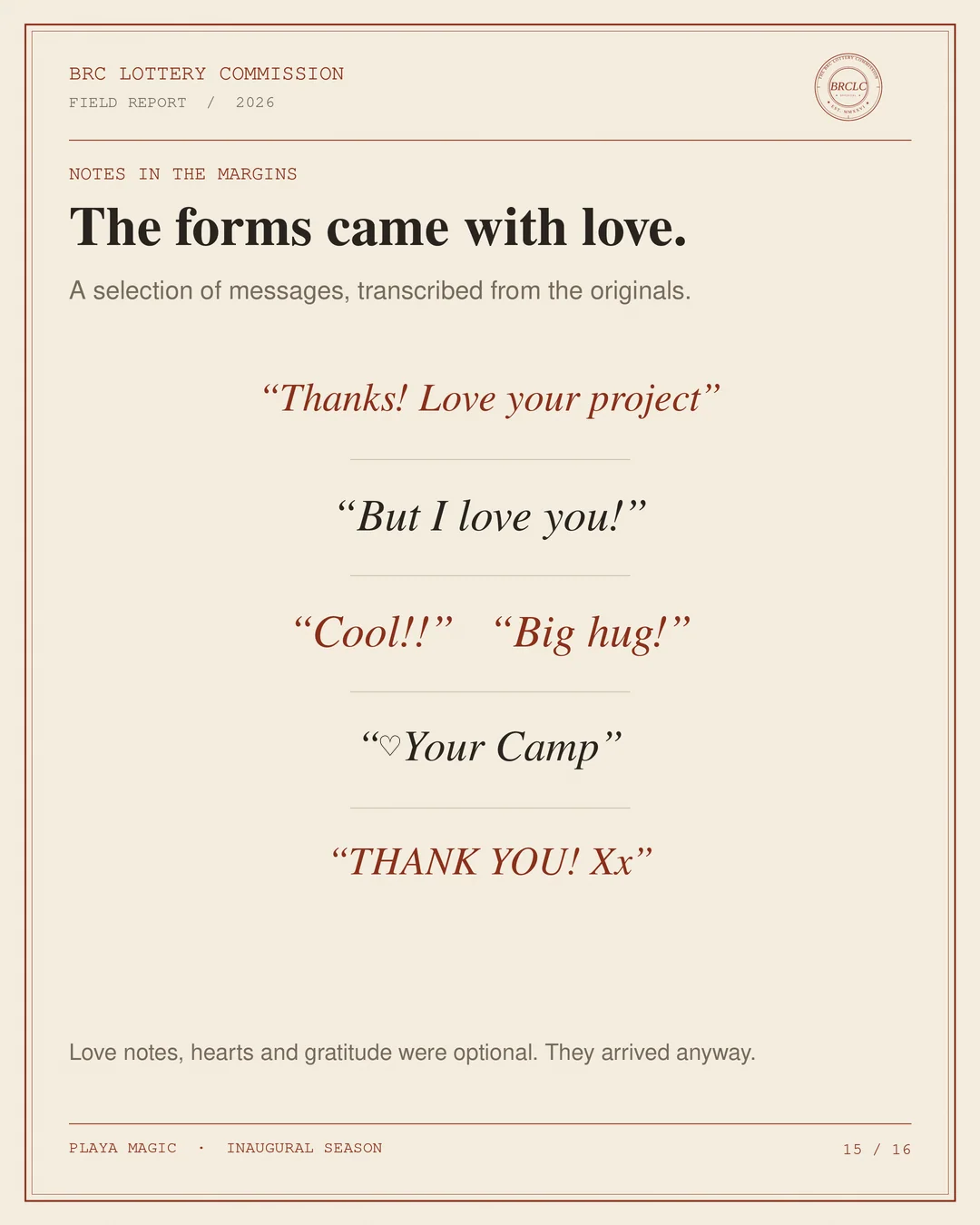
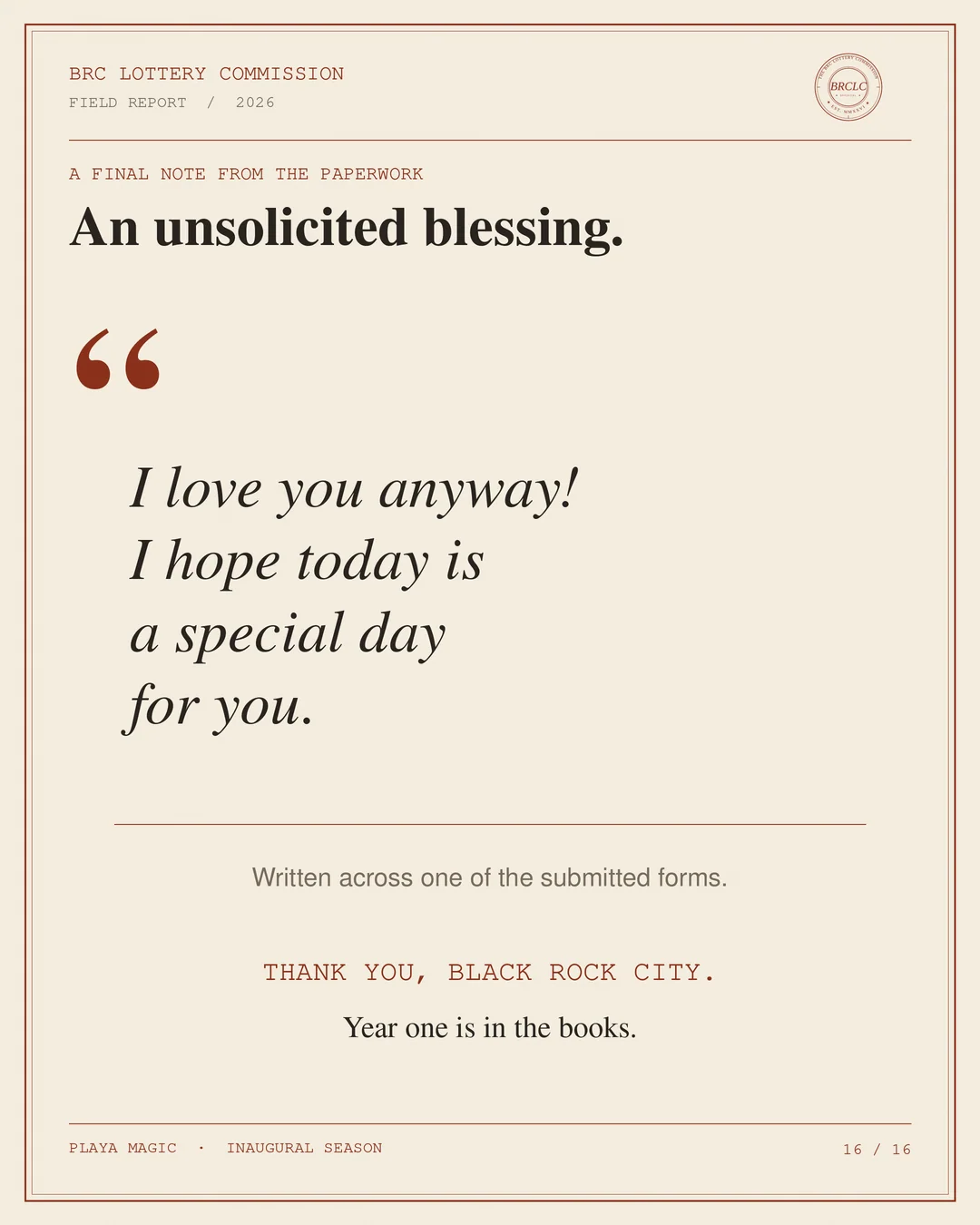
Selected slides from the 2026 public-facing report. Identifying entry-form data and an intentionally withheld names slide are not reproduced here.
Building Playa Magic has meant designing both an experience and the visual artifacts that help people believe in it: a camp identity, a year emblem, an invented civic Commission, official-looking correspondence and a poster that treats a free gift lottery with the gravity of a national election.
The humor matters, but so does the care. A ridiculous stamp can be a reason to approach a stranger. A chance drawing can be a reason to deliver a gift. A piece of invented bureaucracy can, improbably, make a very real human connection feel ceremonial.
Some of my favorite artifacts were the simplest: Playa Magic stickers. I gave them away to people I met around the city, and on more than one occasion a recipient recognized the design. They’d already seen it stuck somewhere else on playa, and thanked me for the sticker because it had somehow become familiar before we’d even met. That little moment of recognition felt like the idea taking on a life of its own.
Then, in fittingly ironic fashion, the last handful of stickers decided to distribute themselves. During the final day or two of the event, the Ziploc bag holding what remained of my nearly exhausted supply slipped out of my pocket somewhere in deep playa. I have no idea who found it—or whether anyone did—but I like to imagine that someone stumbled across a small cache of Playa Magic and that those stickers are still out there, making improbable connections without me.

The next chapter of Playa Magic is about gathering the people who want to make the improbable a little more likely for everyone else.
The long-term vision is a standalone camp and creative community — a place for participatory art, unexpected encounters, shared responsibility, and friendships that remain when the dust settles. A larger 2027 camp is a direction under development, not a finished promise.
I want Playa Magic to be welcoming without becoming passive, playful without becoming performative, and radiant without making anyone feel like they need to earn a place. More than a place to stay, it should become a reason to show up for each other.
I have plenty of other visions I’d love to bring to life under the Playa Magic name: more unusual invitations, playful experiments, shared rituals, and experiences that make people wonder how on earth they ended up in exactly the right place at exactly the right time. But a camp with a genuinely welcoming culture shouldn’t be built from only one person’s imagination.
This is an open invitation. If the idea resonates with you—whether you’re an artist, builder, organizer, storyteller, problem-solver, longtime Burner, first-timer, or simply someone who loves helping improbable moments happen for other people—I’d love to connect. Bring your curiosity, your ideas, and your willingness to participate. Let’s see what kind of magic we can make together.
Connect with Playa Magic Explore the rest of my work ↗Independent participatory art project. Not an official Burning Man program.